What to do while you wait for mediation? Nine tools to see clearly
Weeks can pass between the moment a conflict weighs on you and the moment mediation happens. These nine free tools may help you settle down, see the situation differently and, if the time is right, open the conversation. Each rests on published studies, and its level of evidence and limits are stated on its sheet.
Quick reference visuals
Two memory aids to keep at hand, drawn from Thalia Lamhene's teaching material and from the literature cited on each sheet.
Four steps to talk about a sensitive topic
Describe the situation factually.
Define and own your feelings.
Name the needs behind those feelings.
Make a request that matches those needs.
What closes, what opens a conversation
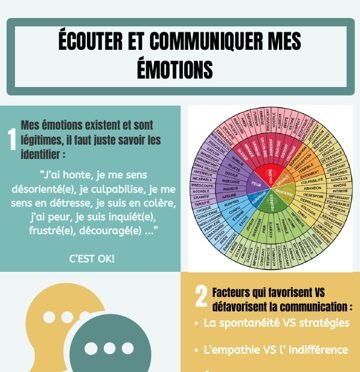
Downloadable sheet: Listening to and communicating my emotions (French)
A one-page summary of identifying emotions, what helps or hinders communication, the four steps to communicate and the types of listening. Thalia Lamhene, 2025. All rights reserved.
While you wait: six benchmarks
- 1
Write down the facts, with dates
A short notebook (what, when, who) keeps an exact memory of what happened and serves mediation as well as any recourse. Practice benchmark.
- 2
Delay emotionally charged messages
Write the draft, wait at least a few hours, reread. How a discussion begins can weigh heavily on what follows (Carrère and Gottman, 1999, in couples).
- 3
Keep it confidential
Involving social media or a wide circle often hardens positions and can complicate mediation. Practice benchmark: confide in one or two trusted people.
- 4
Check time limits and recourses
Some recourses have time limits, for example 2 years for a psychological harassment complaint to the CNESST. Legal advice, even brief, helps you avoid missing them.
- 5
Do not confront if you are afraid
In case of threats, control or possible reprisals, do not contact the other person on your own. Support resources and an individual meeting with a mediator are the first steps.
- 6
Look after what does not depend on the conflict
Sleep, meals, activity, people who support you. This is common-sense guidance, not a result specific to conflicts: a long conflict wears you down, and a tired person reacts faster.
What these tools are, and are not
They are self-reflection tools, inspired by published studies and by conflict coaching, which supports one person to clarify their situation and prepare for dialogue (Brinkert, 2006). They are free, need no account, and nothing you write is saved or sent.
They are not therapy, legal advice or a way to convince the other person. None has been tested as is in a real conflict, and none guarantees to ease your situation. If your distress grows, talk to a professional.
Immediate help
Free and confidential services in Québec.
- 911 Immediate emergency911
- Info-Social (option 2) Psychosocial support, 24/7811
- 1 866 APPELLE Suicide prevention, 24/71 866 277-3553
- SOS violence conjugale 24/71 800 363-9010
- Parents Line Support for parents, 24/71 800 361-5085
- Tel-jeunes Young people aged 5 to 201 800 263-2266
Want a personalized order of work?
The quick overview suggests which tool to start with, based on your situation.
References
The levels of evidence stated on each sheet summarize this work. The assessment and its method are described on the Method and references page. Method and references.
- Moore, C. W. (2014). The Mediation Process: Practical Strategies for Resolving Conflict (4th ed.). Jossey-Bass.
- Fisher, R., & Ury, W. (1981). Getting to Yes: Negotiating Agreement Without Giving In. Houghton Mifflin.
- Robinson, R. J., Keltner, D., Ward, A., & Ross, L. (1995). Actual versus assumed differences in construal: "Naive realism" in intergroup perception and conflict. Journal of Personality and Social Psychology, 68(3), 404-417.
- Zartman, I. W. (2000). Ripeness: The hurting stalemate and beyond. In P. C. Stern & D. Druckman (Eds.), International Conflict Resolution After the Cold War (pp. 225-250). National Academy Press.
- Brinkert, R. (2006). Conflict coaching: Advancing the conflict resolution field by developing an individual disputant process. Conflict Resolution Quarterly, 23(4), 517-528.
- Balban, M. Y., Neri, E., Kogon, M. M., et al. (2023). Brief structured respiration practices enhance mood and reduce physiological arousal. Cell Reports Medicine, 4(1), 100895.
- Lieberman, M. D., Eisenberger, N. I., Crockett, M. J., Tom, S. M., Pfeifer, J. H., & Way, B. M. (2007). Putting feelings into words: Affect labeling disrupts amygdala activity in response to affective stimuli. Psychological Science, 18(5), 421-428.
- Gross, J. J. (2002). Emotion regulation: Affective, cognitive, and social consequences. Psychophysiology, 39(3), 281-291.
- Kross, E., Bruehlman-Senecal, E., Park, J., et al. (2014). Self-talk as a regulatory mechanism: How you do it matters. Journal of Personality and Social Psychology, 106(2), 304-324.
- Galinsky, A. D., Maddux, W. W., Gilin, D., & White, J. B. (2008). Why it pays to get inside the head of your opponent: The differential effects of perspective taking and empathy in negotiations. Psychological Science, 19(4), 378-384.
- Frattaroli, J. (2006). Experimental disclosure and its moderators: A meta-analysis. Psychological Bulletin, 132(6), 823-865.
- Carrère, S., & Gottman, J. M. (1999). Predicting divorce among newlyweds from the first three minutes of a marital conflict discussion. Family Process, 38(3), 293-301.
- Gibb, J. R. (1961). Defensive communication. Journal of Communication, 11(3), 141-148.
- Rosenberg, M. B. (2003). Nonviolent Communication: A Language of Life (2nd ed.). PuddleDancer Press.
- Bower, S. A., & Bower, G. H. (1976). Asserting Yourself: A Practical Guide for Positive Change. Addison-Wesley.
- Rogers, C. R., & Farson, R. E. (1957). Active Listening. Industrial Relations Center, University of Chicago.
- Itzchakov, G., Kluger, A. N., & Castro, D. R. (2017). I am aware of my inconsistencies but can tolerate them: The effect of high quality listening on speakers' attitude ambivalence. Personality and Social Psychology Bulletin, 43(1), 105-120.
- Itzchakov, G., DeMarree, K. G., Kluger, A. N., & Turjeman-Levi, Y. (2018). The listener sets the tone: High-quality listening increases attitude clarity and behavior-intention consequences. Personality and Social Psychology Bulletin, 44(5), 762-778.
- Weger, H., Castle Bell, G., Minei, E. M., & Robinson, M. C. (2014). The relative effectiveness of active listening in initial interactions. International Journal of Listening, 28(1), 13-31.