
Free conflict assessment and mediation in MontréalMediation, dialogue & transparency
A conflict weighing on you? The free assessment helps you see clearly: what's happening, what's fuelling it, and where to go from here.
Stage 4 of 9, moderate intensity
First step: settle down, then fill in the situation sheet before any conversation.
What the assessment gives you, in one minute
Understand where the tension stands, get tools that fit, keep your sheets and compare your readings as a pair.
Read the video text
- Your conflict assessment in a few clicks. Free, confidential, in 5 minutes.
- “We're going in circles.” “I can't talk to you anymore.” “Ok, never mind.” What's really going on? The Onesence assessment helps you put it into words.
- In 5 minutes, you identify where the tension stands, what feeds it, your needs and where to start, so you can choose the right next step.
- Start in one click: the quick overview takes about 5 minutes. Free, confidential, no account.
- Clear results, right away: where you stand, what keeps the tension going and one action for this week.
- Then, tools that fit, chosen from your results among 9 free tools.
- Want to go further? The in-depth assessment gives more precise results, in charts: what feeds the conflict, your reactions and the other person's.
- Keep your sheets: your results and the full tool content, as PDF, to bring to a mediation, to your manager or before an important conversation.
- New: compare your readings, as a pair. Each person takes the assessment and gets a code, then one shared reading, without saying who is right.
- Take stock, at your own pace, at apponesence.ca.
Music composed for Onesence, using FluidR3 GM instrument sounds (CC BY 3.0 license).
0
The assessment: see clearly before you act
In 5 to 12 minutes, the assessment helps you separate the facts, how you feel and what you need, and offers a first reading of your situation, even if you never book a meeting.
Where the conflict stands
A stage on a 9-step scale and an intensity index, to estimate whether the situation can still be defused easily.
What is fuelling it
Six possible sources, ranked from your answers. Sometimes the underlying issue is not the one you argue about.
Your readiness to dialogue
What may hold you back, what may help, and ideas for what comes next, after a safety check.
Something to reflect on and act on
Your words reshaped, targeted questions and tools to settle down and prepare the conversation.
- Circle of Conflict (Moore)
- 9 escalation stages (Glasl)
- Five response modes (Thomas, 1976)
- Safety questions first
See the difference between both versions
Free. Your answers stay in your browser. This is neither a clinical diagnosis nor legal advice.
Take the assessment as a pair
Each person takes the assessment alone, on their own side. Then, if you both want to, you compare your readings on one page: where they meet, where they differ, without saying who is right.
Which situation is closest to yours?
Each page presents possible first steps, an overview of options in Québec, and leads to the quick overview with your context already chosen.
Nine free tools, ready to use right now
No appointment or assessment needed first. An emotion wheel, a situation sheet, a guide for saying what matters: each tool spells out what the research says and its limits.
An assessment built on mediation models
Every conflict holds the potential for better understanding. The assessment draws on published frameworks, and says clearly what it does not do.
- 9escalation stages
To locate where the tension stands, from a hardening discussion to a breakdown (Glasl).
- 6sources of conflict
Facts, relationship, values, structure, interests and external factors (Moore, Furlong).
- 7safety questions
Asked first, so that dialogue is never suggested when it could put someone at risk.
The Founder
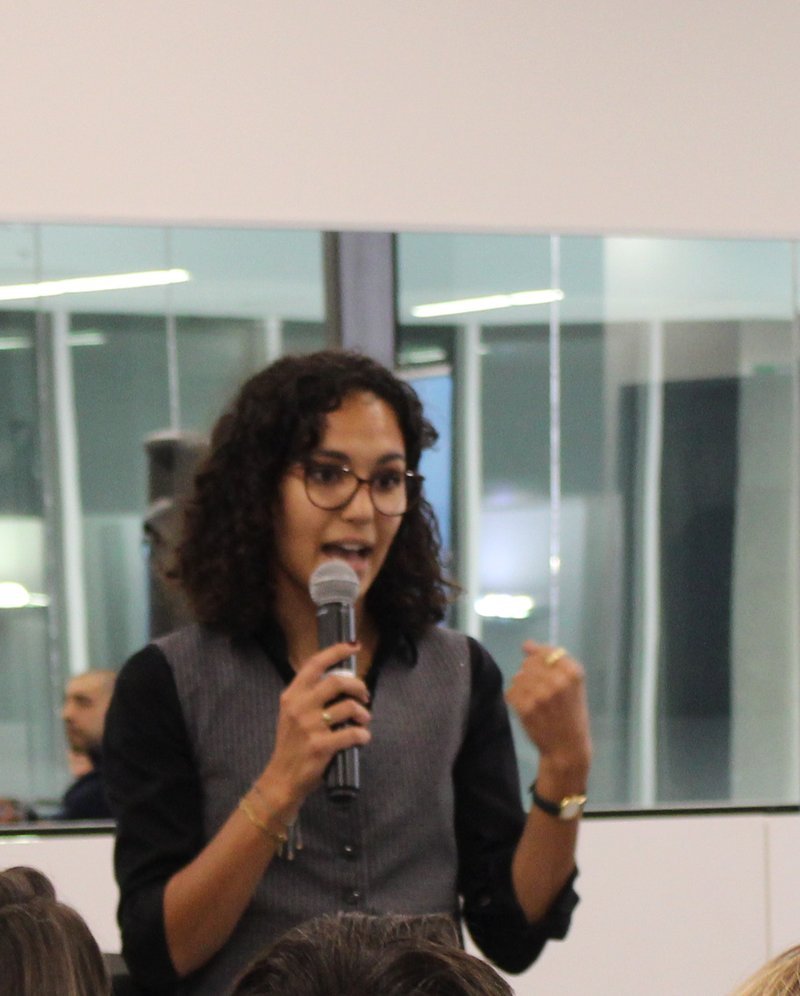
Thalia Lamhene is a mediator accredited by the Institut de médiation et d’arbitrage du Québec (IMAQ) and founder of Onesence, a civil and parent-youth mediation service based in Montréal.
Day to day, she leads social mediations in public spaces, between merchants, young people, people experiencing homelessness and institutions. She has led parent-youth mediations, often through shuttle mediation, in a violence prevention project, and has trained intervention teams in mediation using an intercultural and intergenerational approach.
Trained in sociology and criminology, she holds a graduate diploma in conflict prevention and resolution from the Université de Sherbrooke and the ESSEC Mediation and Conflict Resolution certificate, and is a Peacebuilder with Mediators Beyond Borders International.
- IMAQ-accredited mediator
- Graduate diploma in conflict prevention and resolution
- Confidential, voluntary process
- Day-to-day social mediation in the field
Mediation on request (civil, parent-youth, training): currently paused. See the services
Take stock, at your own pace
The assessment is free and your answers stay in your browser. If the other person takes it too, you can compare your two readings.